APPLICATION
/ Cased Hole Services
/ Geothermal
/ Well Integrity
/ Flow Logging
TECHNOLOGY
/ Cased Hole Services
/ Vulcan MFT-40
/ Vulcan FLS 2.25
LOCATION
/ Asia Pac
DOWNLOAD CASE HISTORY
/ PDF File
CUSTOMER CHALLENGE
As part of an operator’s well integrity system and monitoring, a geothermal field was selected for a comprehensive caliper logging campaign. The field is known for its complex and unstable formation conditions, with a history of drilling challenges, including multiple bottom hole assembly (BHA) sticking incidents.
Several wells that were overdue for integrity diagnostics were prioritized to assess potential casing damage and deformation. The objective was to accurately identify and quantify integrity issues, enabling the operator to screen and rank wells requiring remedial intervention.
These operations presented significant technical challenges, including extreme downhole temperatures and harsh well conditions. As a result, the campaign required robust, high-temperature-rated diagnostic tools capable of delivering reliable, high-resolution data to support informed decision-making and proactive asset management.
SCIENTIFIC SOLUTION
From well diagnostics through to performance evaluation, Scientific Drilling’s cased hole technologies provided a comprehensive solution for the campaign. During the caliper survey, the Vulcan™ MFT-40 Multifinger Caliper was deployed to assess casing geometry and integrity, successfully identifying areas of deformation, damage, and scale-related anomalies requiring immediate attention.
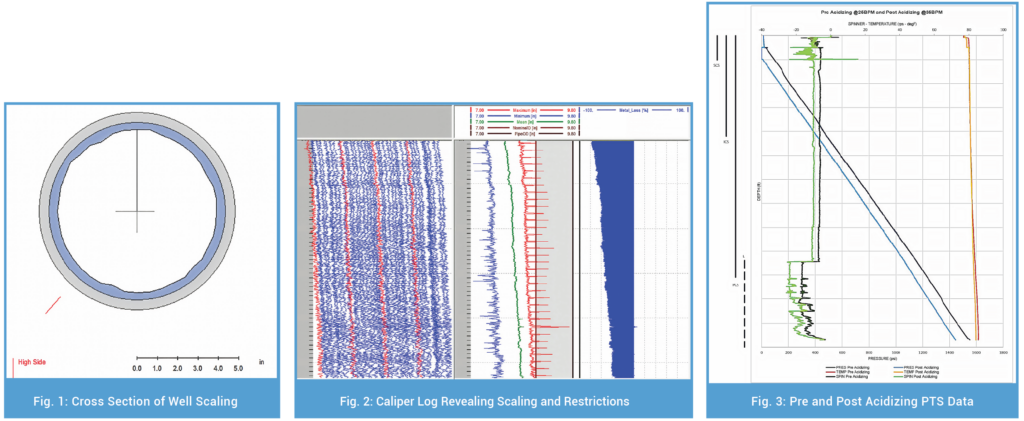
The fully digital MFT-40 tool, rated to 343°C, was deployed across 10 wells with an average operating temperature of 208°C. The highest recorded temperature, 225.7°C, was observed in Well-9. Data acquired from this well indicated substantial scale deposition, with an average radial restriction of 12.8% and a corresponding flow area reduction of 8.8% (see Figures 1 and 2).
Scale accumulation was observed throughout the logged interval, with severity increasing toward the surface. This progressive restriction raised concerns regarding its direct impact on injection performance. Based on these findings, Well-9 was prioritized for remedial intervention, including mechanical scale removal and chemical dissolution.
Subsequently, the Vulcan™ FLS (2.25”) was deployed to evaluate the effectiveness of the scale removal program. Comparative pre- and post-intervention production logging (PTS) data confirmed a measurable improvement in well injectivity and overall performance (see Figure 3).
Client VALUE
Geothermal operations demand reliable, high-accuracy diagnostic technologies capable of performing under extreme downhole temperatures. Through the execution of this caliper campaign and subsequent workover activities, the operator gained critical insights into well integrity and condition without the need for well quenching, thereby minimizing operational disruption and cost.
The high-resolution caliper data provided a detailed understanding of casing condition and scale distribution, enabling effective field-wide assessment and prioritization of wells requiring immediate intervention. In addition, real-time production logging (PTS) data offered direct validation of the workover program’s effectiveness, confirming improvements in well injectivity and overall performance.
Collectively, these results supported data-driven decision-making, optimized intervention planning, and enhanced confidence in the long-term management of the geothermal asset.
YOU MAY ALSO BE INTERESTED IN
Reducing Risk and Rig Time in High-Angle Sidetrack with URSA gyroMWD